
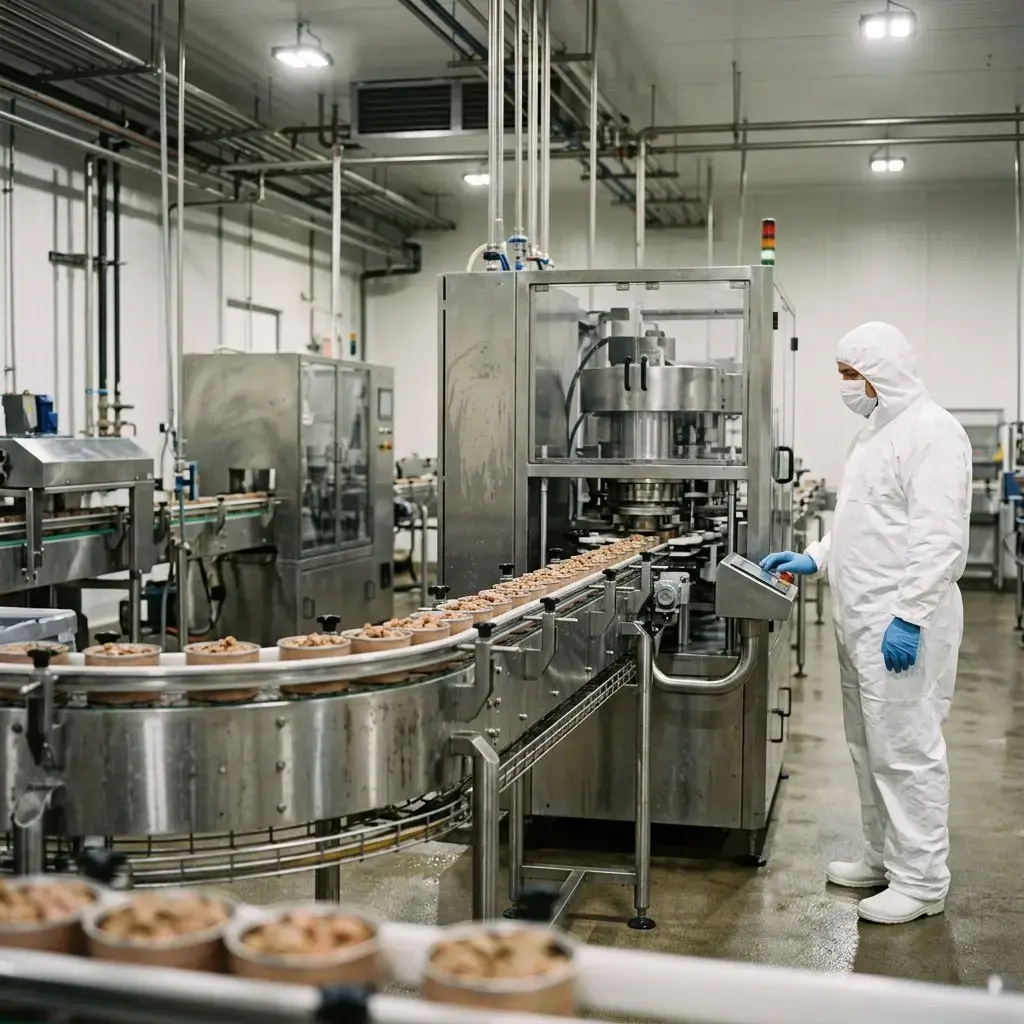

Commercial wet dog food is usually made by preparing a balanced recipe, filling cans, trays, or pouches, sealing them, and then applying thermal sterilization. That sequence is what makes most ambient wet food safe and shelf-stable.
The exact route varies with product style. A loaf or pâté behaves differently from a mousse or chunks in gravy or jelly, so formulas, filling behavior, and heat transfer often need adjustment during pet food pilot production. Even so, the goals stay the same: safety, consistency, and usable shelf life.
This article focuses on industrial production rather than homemade cooking. Later sections also answer common questions about naming rules and home preparation.
How the recipe is prepared before it reaches the line
Wet dog food production starts with recipe design and a clear pet food formulation brief. Protein sources and supporting ingredients are selected and weighed to meet the nutritional target for the intended life stage or feeding purpose. The formula also has to work in processing, not just on paper, so texture, moisture, and pack performance are considered from the start.
Raw materials may arrive chilled or frozen, then be thawed as needed, staged, chopped, minced, or ground before mixing. Product style has a major effect on formulation: loaf-style products, mousse, and chunks in gravy or jelly each need a different moisture balance and texture system. Manufacturers also formulate to the right product type. Complete wet food is intended to provide the full diet when fed as directed, while a complementary product is designed to be fed alongside other foods, so the formulation target is different from the outset.
How wet dog food is mixed and portioned into cans, trays, or pouches
Once ingredients are prepared, batches are commonly mixed in kettles or similar equipment. Water or broth is often added early in the sequence, followed by fats, premixes, and other functional ingredients that support distribution, texture, or process performance. Meat materials and any visible inclusions are then blended under controlled conditions so the batch stays uniform.
After mixing, the product moves to the filler and is portioned into cans, trays, or pouches at controlled weights. This stage is important for even nutrient distribution, consistent appearance, and repeatable texture from one pack to the next. The line setup changes with the package format, because rigid cans, semi-rigid trays, and flexible pouches do not flow, fill, or handle in exactly the same way.
How sealed packs are sterilized for safety and shelf life
Most shelf-stable wet dog food is sealed before thermal processing, so the product is sterilized inside its final pack. Retort processing uses controlled time, temperature, and pressure to destroy harmful microorganisms and create ambient shelf stability. That heat step also affects texture, moisture retention, and palatability, so manufacturers balance safety with finished-product quality. By contrast, pasteurized chilled or frozen wet products depend on colder distribution and typically have a shorter shelf life.
Which control points matter most during production
Wet dog food lines rely on checks that confirm both food safety and pack integrity. The exact control plan depends on the product and market, but the points below are commonly important.
| Control point | What it verifies | What it helps prevent |
|---|---|---|
| Recipe, moisture, or nutrient checks | The batch matches the intended formulation | Nutritional drift, texture issues, and label mismatch |
| Product temperature | Raw, mixed, filled, and post-process conditions stay within target | Microbial risk and unstable processing |
| Fill-weight control | Each pack is portioned correctly | Underfills, giveaway, and pack variation |
| Seam or seal integrity | Cans, trays, or pouches are properly closed | Leaks, recontamination, and shelf-life failure |
| Vacuum or headspace checks | The internal pack condition is within target | Weak closures and reduced stability |
| Metal detection | Packs are screened for metal contamination | Physical contamination risk |
| Sanitation controls | Cleaning and line hygiene are maintained | Cross-contamination during handling |
| Batch coding and records | Materials, settings, and results stay traceable | Poor traceability if a deviation occurs |
| Pilot runs and validation | New products are checked through shelf-life, packaging, and regulatory review | Scale-up problems at launch |
For pet-industry companies scaling a new wet product, GC Consulting can support related technical services such as label control, packaging design, analytical testing, and regional regulation guidance.
What happens after retort: cooling, coding, packaging, and distribution
- Packs are cooled in a controlled way after thermal processing to protect product quality, seal performance, and pack appearance.
- Date or batch codes are printed or checked, and labels or on-pack print are verified for accuracy and traceability.
- Primary and secondary packaging are prepared for storage and transport so the product stays protected from contamination, handling damage, and exposure to oxygen, moisture, or light where relevant to the format.
- Shelf-stable wet food can move through ambient warehousing and distribution, while chilled or frozen variants need cold-chain handling.
Related questions about dog food rules and home preparation
The rules used to name a dog food are separate from the manufacturing steps above. A product can be safely produced yet still need market-specific checks on composition claims and label wording. Homemade wet food also differs from commercial wet food because it does not use the same validated sterilization, packaging, and shelf-life controls.
What is the 95% rule in dog food?
The 95% rule is a product-naming and composition rule used in some regulatory systems, not a manufacturing-stage requirement. In those markets, if one ingredient dominates the product name, that ingredient generally needs to make up at least 95% of the formula excluding added water for processing. This rule does not, by itself, say whether the food is nutritionally complete. Any naming claim should be checked against the local standard before launch.
What is the 80/20 rule for dog food?
There is no universal 80/20 rule that governs wet dog food manufacturing. People use that phrase in different ways, often as informal recipe guidance or feeding shorthand, so it should not be confused with official naming rules. Commercial wet dog food is formulated against nutrient requirements, process needs, and legal labeling rules for the target market rather than one fixed ratio that applies everywhere.
Can I make my own wet dog food?
Yes, you can make wet dog food at home, but homemade cooking is not the same as commercial wet-food manufacturing. If the food is meant to be a complete diet, it still needs balanced protein, fat, vitamins, minerals, and moisture. Without validated industrial processing and sealed shelf-stable packaging, homemade wet food is usually refrigerated or frozen rather than stored at room temperature. For a fully homemade diet, veterinary nutrition guidance is important.
Is it cheaper to make your dog food or buy it?
It depends on more than ingredient price. The real comparison includes ingredient quality, supplements, labor, energy use, storage, and food waste, not just the cost of meat. Commercial manufacturers benefit from scale, automated filling, and longer validated shelf life, which often improves cost efficiency per safe, balanced serving. Homemade food may seem cheaper at first, but total cost rises once complete formulation, refrigeration or freezing, and prep time are included.