
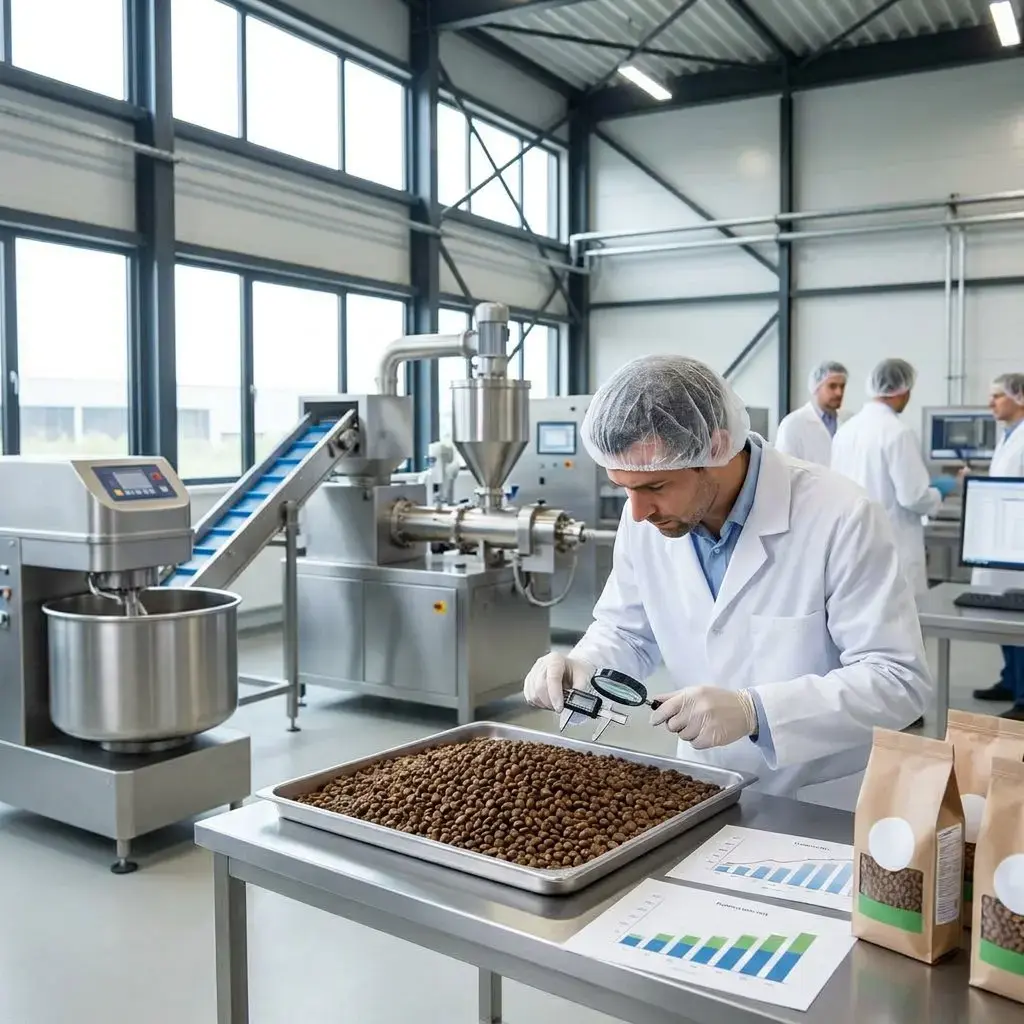

Pet food pilot production sits between product development and full factory output. It lets teams test a recipe on pilot-scale equipment, measure how it behaves during processing, and decide whether the product is ready for commercial manufacture. For brands, manufacturers, and exporters, that step reduces risk before larger purchasing, packaging, and market-entry commitments are made.
In practice, pilot runs are not only about making samples. They are about generating decision data on process settings, kibble structure, coating performance, palatability impact, and technical readiness for launch.
Why pilot runs matter before commercial production
A recipe that works in the lab does not automatically work in production. Changes in shear, moisture, temperature, drying time, or fat application can alter density, texture, stability, and appearance. Pilot production helps teams find a realistic process window, compare formulation options, and identify weak points before moving to full-scale capacity. It is especially useful when you are launching a new range, changing ingredients, or adapting a product for a new market.
What a pilot run should confirm
For dry pet food, the most useful trials follow the real production chain as closely as possible, from raw material preparation to extrusion, drying, cooling, and coating.
Process behaviour and kibble quality
This stage shows how recipe composition and process settings interact. Teams can assess expansion, moisture, bulk density, fat uptake, kibble integrity, and how the kibble matrix responds to different ingredient systems or market positionings, from standard to premium. That makes it easier to judge whether a formulation is robust or still too sensitive for commercial manufacture.
Samples, data, and next-step decisions
Pilot batches also create representative samples for internal review, customer validation, packaging checks, and shelf-life work, building on earlier pet food concept validation. Just as important, they generate production data that supports scale-up decisions, troubleshooting, and discussions with manufacturing partners.
| Focus area | Typical check | Why it matters |
|---|---|---|
| Formulation | Ingredient functionality, inclusions, binder and fat behaviour | Confirms whether the recipe is production-ready |
| Processing | Extrusion, drying and coating response | Reduces scale-up surprises |
| Product quality | Texture, density, stability and appearance | Supports consistent market quality |
| Launch readiness | Samples for packaging, technical and shelf-life checks | Improves decision-making before launch or export |
Where pilot production creates the most value
New ingredients and reformulation
Pilot trials are particularly useful when evaluating alternative proteins, palatants, binders, fibres, or fat systems. They show whether an idea is commercially workable, not only technically interesting, and whether it matches the original pet food formulation brief.
Process optimisation and troubleshooting
When a product shows inconsistency in expansion, coating pick-up, drying, or durability, pilot work helps isolate the cause. That can save time and factory capacity later and guide follow-up technical services if needed.
Launch and export preparation
Pilot output can also support packaging evaluation, analytical planning, label review, and technical documentation for target markets. For export-oriented projects, this makes the pilot phase more useful than a simple sample-making exercise.
How GC Consulting supports pilot projects
GC Consulting, based in Erembodegem and active internationally, helps pet industry companies treat pilot production as part of a wider launch plan. That means aligning trial objectives with new product development, technical services, sourcing decisions, and target-market requirements.
- Trial objectives and success criteria
- Ingredient, supplier, and recipe coordination
- Label, packaging, and technical checks
- Export-oriented next steps after the trial, including a pet food co-manufacturer checklist
For companies creating a new pet food brand or preparing products for broader distribution, this joined-up approach turns pilot output into clearer commercial decisions, as shown in a case on formulation support and operational training.
FAQ about pet food pilot production
When should a brand move to pilot scale?
Usually once a formula looks promising in development, but before commercial production slots, packaging volumes, or export commitments are confirmed.
Is pilot production only relevant for dry pet food?
No. The same logic applies across formats, but it is especially important in dry food and treats, where process settings strongly influence structure, coating, and consistency.
What is the main output of a successful pilot run?
Not just samples, but usable data on formulation limits, process conditions, product quality, and the next actions needed for scale-up or launch.